All Posts
Webflow
10
min read
Published on
September 16, 2026
Webflow Source explained: what it is, what changes, and what it means for your B2B website

Yannik Moll
CEO
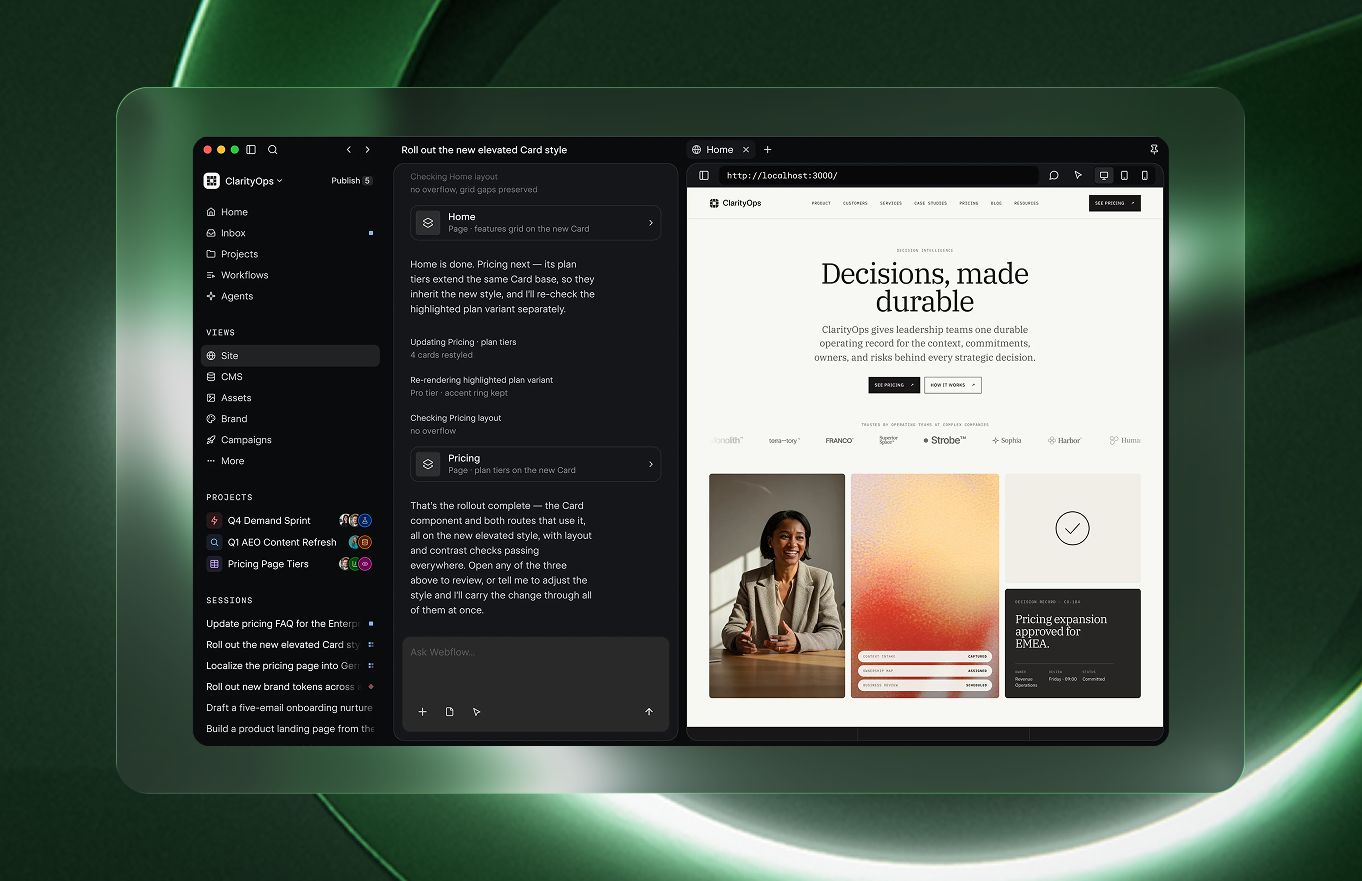
On September 2, 2026, Webflow announced Source at Webflow Conf in Boston. Our founders Yannik and Tobi were in the room, and it was the moment the whole conference had been building towards. Webflow didn't launch a new feature. It launched a new product line, and with it a fairly clear statement about what a website is supposed to be from now on.
In this post we'll explain what Webflow Source is, how it works, what it means for B2B marketing teams, and how we as a Webflow Enterprise Partner think about our role as a Webflow Source agency. We'll also be upfront about what we don't know yet, because there is quite a bit of that.
If you want the background on the technical shift that made Source possible, we wrote about it in July: Webflow just made code the source of truth. This post picks up where that one left off.
What is Webflow Source?
Webflow Source is a new platform from Webflow where marketing teams and AI agents work on a website together. It works directly on code (your own codebase or Webflow's), connects to your existing CMS, hosting, and marketing tools, and wraps everything in governance: brand systems, approval workflows, and audit trails. Every marketer, designer, and developer gets a workspace tailored to their role, and agents continuously measure the site, recommend improvements, and act on them within limits you define.
Webflow's own tagline is "where marketers and agents run the web". The key word is run. Source is not primarily a tool for building a website. It is a tool for operating one after launch.
As of September 2026, Source is in a limited research preview. Selected agencies and customers are being onboarded in phases, and pricing has not been announced.
What Webflow Source is not
Before going deeper, three clarifications, because our team has seen some confusion in the community since the announcement.
Source is not Webflow 2.0. The Webflow platform you build on today continues, and Webflow is still shipping heavily for it: MCP 2.1, Agent Instructions, Agent Presence, Releases, the AEO content agents, and a long list of Designer improvements were all announced at the same conference. Webflow has said there will be a supported migration path to Source when teams are ready, but nobody is forced to move.
Source is not "AI builds your website". AI making changes to a website is not new. You can already do a lot of that with Webflow's MCP server and a coding agent. What Source adds is the layer around it: who is allowed to do what, how changes get reviewed, how the brand stays intact, and how a whole team works with agents rather than one developer in a terminal.
And Source is not Webflow-only. It connects to sites built in Webflow, but also to codebases built with frameworks like Next.js, and you can deploy to Webflow Cloud or your own infrastructure. That is a bigger strategic move than it sounds, and we'll come back to it.
How Webflow Source works: the five building blocks
Webflow describes Source through a handful of primitives. Here is our understanding of each one based on the keynote, the product page, and Webflow's launch post.
1. Code as the foundation
In Source, code is the source of truth. Agents don't work on an abstraction layer that gets compiled into something else. They work on the actual production code, which means they can make substantial changes (scaffold a new build, switch a site from light to dark mode, generate on-brand variants for a campaign) without hitting the ceiling that visual builders usually impose.
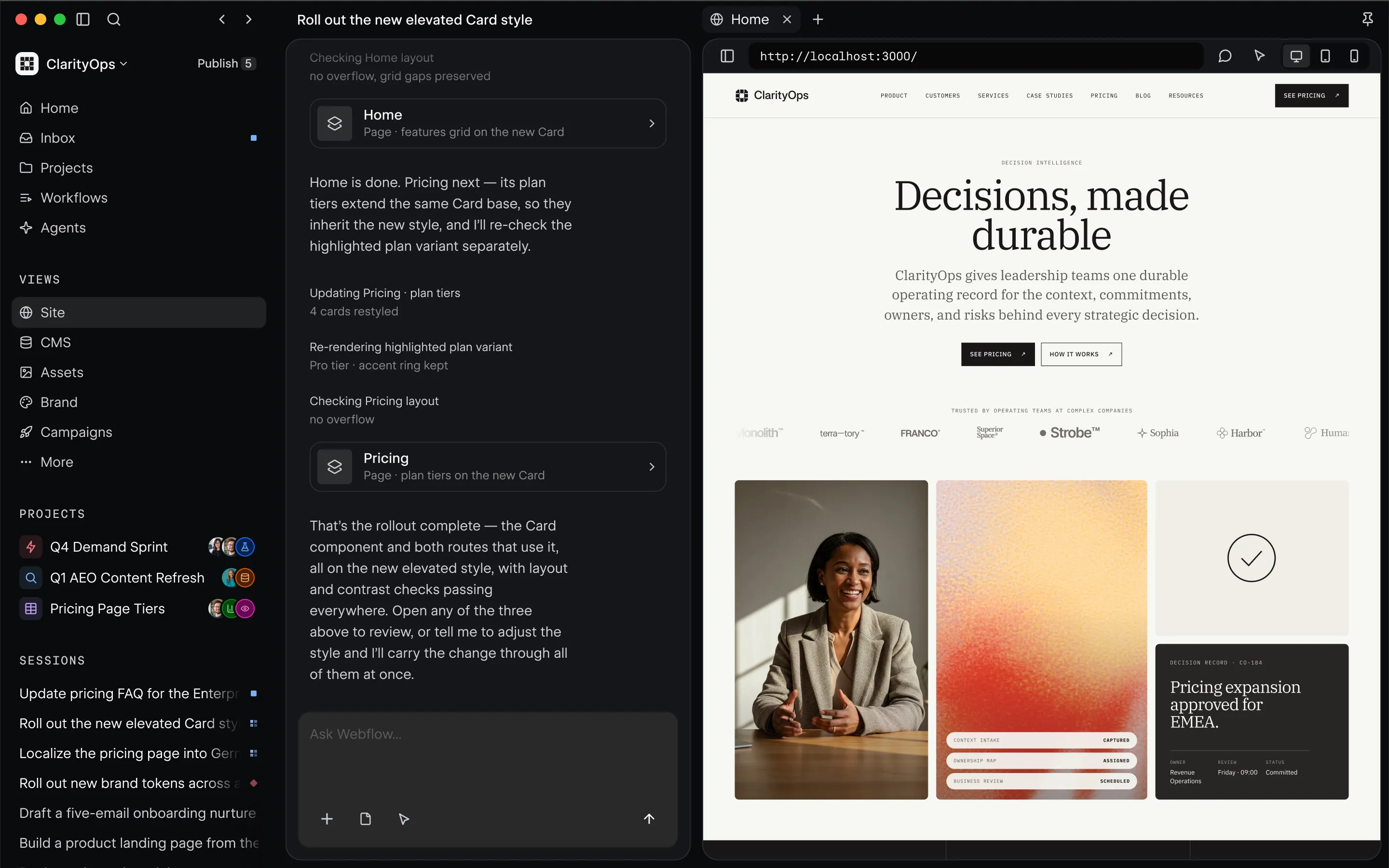
At the same time, the visual canvas is still there. You can let an agent do the heavy lifting and then fix a headline's font size by hand because that is faster than prompting. Webflow frames it as never trading off speed, control, and craft. We'll see how well that holds up in practice, but the intention is right.
2. Views: a workspace for every role
Views are the new workspace primitive. Instead of one Designer that everyone has to learn, each person gets a surface built around the jobs they own. Webflow ships default Views for visual site building, content management, assets, optimization, audit, and an inbox. Teams can also create custom Views, for example a dashboard that only shows the metrics the CMO cares about, or a View built around your specific content approval process.
For anyone who has ever onboarded a marketing team to a Designer built for designers, this is the feature that solves a very real problem.
3. Agents and the Inbox
Agents in Source are not a chat box. They run continuously, measure the site, and when they see an opportunity (an underperforming page, a missing AEO signal, a customer story that should exist), they draft a recommendation and drop it into your Inbox, ready for approval. You can also build agents scoped to a specific job, like one that checks new pages for brand voice, or one that proposes tests for weak landing pages.
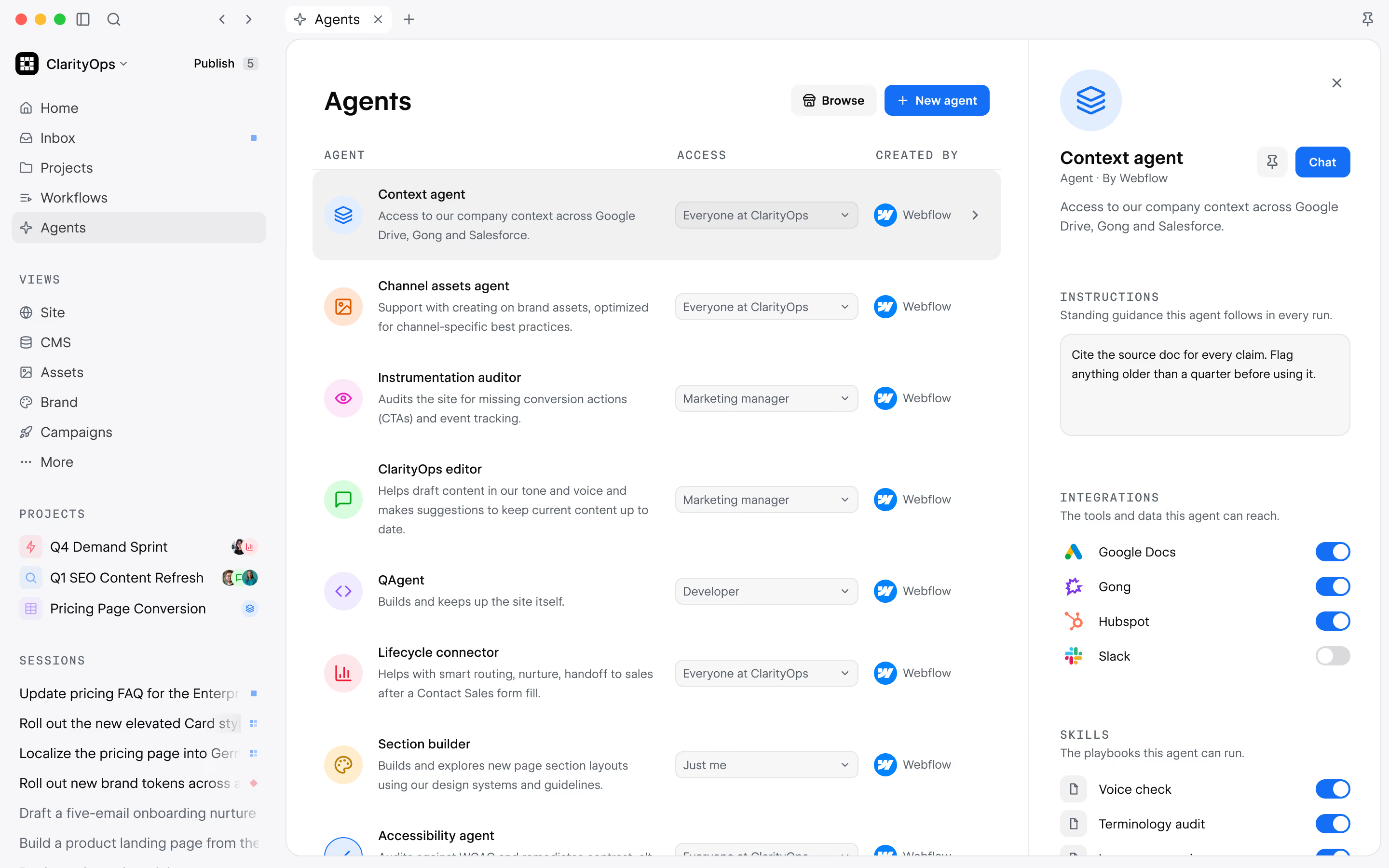
Comments on the canvas can become agent tasks. Leave a note like "update this CTA to the new brand colors", an agent picks it up, drafts the change, and flags it for review.
4. Governance built in
This is the part we care about most. Brand systems, approval paths, and audit trails are part of the platform from day one. Teams decide how much autonomy agents get, from "ship automatically" to "every change needs human sign-off". Every change is attributed: what changed, who or what triggered it, whether it came from Webflow's AI or an external model.
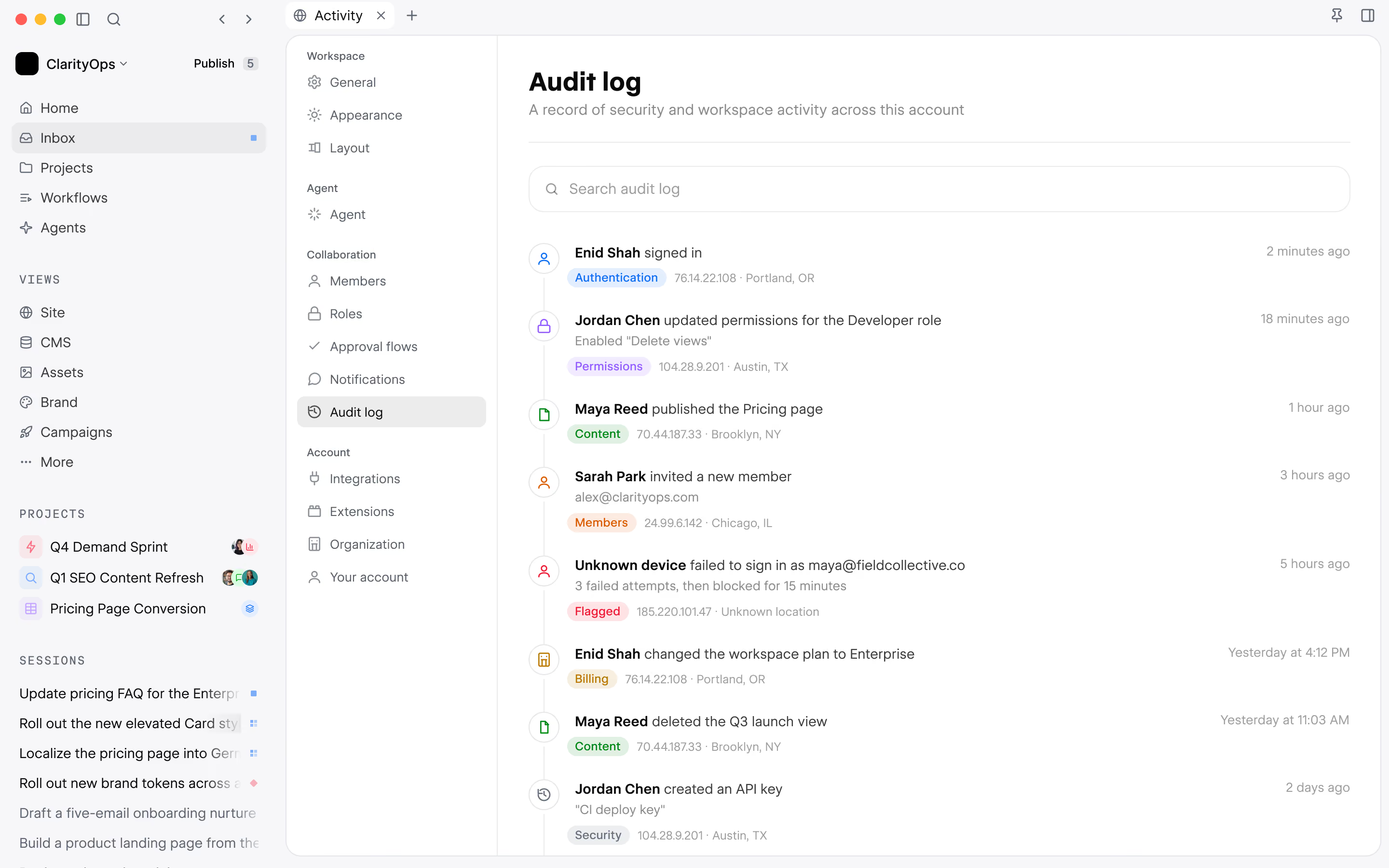
Doing AI changes in a way that is controlled, debuggable, on-brand, and usable by an entire marketing team is a much harder problem than generating a page. Source is the first product we've seen that treats that as the core problem rather than an afterthought.
5. Connect any stack
Source connects to the stack you already run: your codebase, your CMS (or Webflow's new headless, component-based CMS), your martech tools, your hosting. Or you use Webflow's stack for all of it. Either way, Source provides the agents, the Views, and the governance on top.
Why Webflow Source matters: websites need to become systems
The product is exciting. But the bigger takeaway for us is what it implies about how websites need to be built from now on.
If an agent can create a new landing page within minutes, the quality of the underlying system becomes the thing that decides whether that page is an asset or a liability. Websites need to become systems, not collections of individually designed pages.
Concretely, that means asking questions like these about your own site:
- Do you have reusable components, or dozens of one-off sections that each look slightly different?
- Can new pages be assembled from existing patterns without a designer touching them?
- Is your brand encoded strongly enough (colors, type, spacing, tone, imagery rules) that an AI-generated page still feels like your company?
- Have you thought about how your marketing team will actually work with the website six or twelve months after launch?
- Do you have governance around who, or what, is allowed to publish changes?
Most B2B websites we see in relaunch projects would answer "no" to at least three of these. That was a manageable problem when every new page went through a designer and a developer. It stops being manageable when the marketing team and three agents can publish without either.
Branding gets more important, not less
There is a second consequence that doesn't get talked about enough.
When everyone can generate a decent-looking website with AI, "looking professional" stops being a differentiator. It becomes the baseline. What remains is a recognizable brand, a strong point of view, and a website system that translates that brand consistently across hundreds of pages, including the ones an agent generated at 3 a.m.
That is why brand design is part of the foundation in every Growably relaunch, not a nice-to-have on top. In a Source world, the brand system is the guardrail the agents work within. If it is weak or only lives in a PDF, the agents will happily produce a hundred pages that all drift in slightly different directions.
What Webflow Source means for B2B SaaS marketing teams
For an in-house B2B marketing team, we see four practical implications.
The website becomes marketing infrastructure. The campaign brief, the landing page, its variants, the ad creative, the measurement, and the next iteration increasingly live in one system rather than five tools with handoffs between them. Webflow's Campaigns product, announced alongside Source, is built for exactly this loop.
Fewer tools around the website. A lot of the martech layer that grew up around the CMS (experimentation, personalization, asset management, translation) is being pulled into the platform. That can simplify your stack, but it also means the platform choice carries more weight than before.
AEO becomes a website job. Webflow's research found that the median company appears in only 16% of the AI answers it would want to be part of, and is cited in just 6%. A website that ranks and converts is no longer enough. It also has to give AI systems the context to understand and reference your company correctly. Source's agents are designed to work on exactly that continuously.
Post-launch matters more than launch. If the hard part of a website is what happens after it goes live, then the relaunch is the foundation, not the finish line. Budget, team setup, and agency relationships should reflect that.
What a Webflow Source agency actually does
This is the question our team has been asked most since Boston, sometimes with a slightly worried undertone: if Source is this easy to use, what do you still need a Webflow agency for?
Fair question. Our answer is that a Webflow Source agency does less of one thing and much more of another.
Less: getting things onto a page. Building 20 individual pages by hand, one section at a time, is not where the value is going to be. Agents will do a lot of that, and they should.
More: building the system that lets your team create the next 100 pages. That means the component library, the encoded brand system, the CMS architecture, the agent instructions and guardrails, the approval workflows, the Views built around how your team actually works, and the ongoing optimization loop once everything is live.
Webflow itself describes the agency opportunity in three parts on the Source product page, and they map closely to how we already work:
Take on work you used to turn away. Because Source works on real code and any stack, the technical ceiling lifts. Projects that used to require a full custom development team become feasible for a Webflow partner.
Turn your playbook into a product. Custom Views and agents built around a client's operating model can be reused across every project that needs them. Our website strategy process, our CRO playbook, our AEO checks: these become things we configure into the system rather than deliver as slides.
Be the AI consultant your clients are asking for. Most marketing teams know they should be using agents on their website and have no idea how to do it safely. Setting that up, with governance, is a real and sellable service.
At Growably we started moving in this direction about a year ago, before Source existed. We reframed the relaunch as the foundation (brand design plus a component-based technical build) and added ongoing growth retainers for CRO, SEO and AEO on top. Source makes us more convinced that this was the right call, and it gives us a much better platform to deliver it on.
We have applied for the research preview and will share what we learn once we've had our hands on it.
The open questions
We'd rather be useful than enthusiastic, so here is what we don't know yet.
Pricing. Nothing has been announced for Source, Campaigns, or Assets. Webflow is clearly moving towards multiple products, and several of them were announced as "pricing coming soon". For agencies and mid-sized companies this is the single biggest variable.
Maturity. Source is a research preview. The demos were impressive, but a demo is not a production site with 400 CMS items, three locales, and a legal team. We'll judge it when we've used it.
Client readiness. Some clients will want agents running on their website tomorrow. Many are curious but cautious. Some will say no for compliance reasons alone. "AI-first website management" is a spectrum, and a good agency should help each client find their place on it rather than push everyone to the same end.
The Designer question. Webflow has been clear that the current platform continues. But the direction of travel is towards code as the foundation, and Webflow developers who have never worked in a codebase should probably start now. We are treating this as a team development topic, not a threat.
How to prepare for Webflow Source today
You don't need access to the research preview to get ready. Most of the work that makes a website "Source-ready" is work that makes it better anyway.
Audit your components. Count how many unique sections your site has versus how many reusable components. If the first number is much bigger than the second, that is your starting point.
Encode your brand. Design tokens (variables in Webflow), typography scales, spacing rules, imagery guidelines, tone of voice. If it lives in a brand PDF, it doesn't exist for an agent.
Structure your CMS. Clear collections, consistent reference fields, no orphaned content types. Source's headless CMS and Webflow's MCP 2.1 both reward clean content models.
Write your agent instructions. Webflow now generates markdown context files (brand guidelines, design system, assets, CMS structure) that agents can read. Generate them, read them, correct them. This is the closest thing to a Source setup you can do right now.
Define governance. Who can publish? What needs review? What must never change without sign-off? Write it down. In Source these become approval paths; today they are simply good hygiene.
If you want a second opinion on any of these, that is exactly what our website strategy work covers.
FAQ: Webflow Source
What is Webflow Source?
Webflow Source is a new platform from Webflow, announced at Webflow Conf 2026, where marketing teams and AI agents work on a website together. It works directly on code, connects to your existing stack, gives every team member a role-specific workspace (Views), and includes governance such as approval workflows and audit trails.
Is Webflow Source replacing Webflow?
No. The existing Webflow platform continues and is still being actively developed. Source is a separate product line. Webflow has said it will offer a supported migration path for teams that want to move.
Can I use Webflow Source with a Next.js or other custom codebase?
Yes, that is one of its core ideas. Source connects to your codebase, CMS, hosting, and marketing tools, or you can use Webflow's own stack. Deployment can run on Webflow Cloud or your own infrastructure.
When will Webflow Source be available?
As of September 2026, Source is in a limited research preview with phased onboarding for selected agencies and customers. You can apply on webflow.com/source. General availability and pricing have not been announced.
How much does Webflow Source cost?
Pricing has not been announced yet. We'll update this post as soon as Webflow shares it.
What does a Webflow Source agency do?
A Webflow Source agency builds and runs the system behind the website: component library, brand system, CMS architecture, agent setup and guardrails, custom Views and approval workflows, plus ongoing optimization for conversion, SEO, and AEO. Growably is a Webflow Enterprise Partner and has applied for the Source research preview.
Do I need to rebuild my website for Webflow Source?
Not necessarily. Source is designed to connect to existing stacks, including sites built in Webflow. That said, sites built as collections of one-off pages benefit far less than sites built as component-based systems with an encoded brand. In many cases, a relaunch that builds this foundation is the sensible first step.
Want to know whether your website is ready for Webflow Source?
We're a Webflow Enterprise Partner based in Cologne, and we've spent the last year building B2B websites as systems rather than page collections. If you want to know where your site stands, or how Source might change your roadmap, book a free strategy call with us.
Talk to our experts
Lorem ipsum dolor sit amet, consectetur adipiscing elit. Sed vitae purus ipsum

Share
Related Articles
Webflow
Webflow Source explained: what it is, what changes, and what it means for your B2B website
Webflow Source lets marketing teams and AI agents run the website together, with governance built in. What it is, how it works, the open questions, and what it means for B2B marketing teams and Webflow agencies.

Webflow
Webflow just made code the source of truth: a huge shift, and the right one
Webflow's "Getting to the Source" announcement is its biggest change since launch: code becomes the single source of truth. Here's our take on why this AI-first shift is the right move, and what it means for your B2B SaaS website and team.
.jpeg)
No one ever regretted planning a website project “too early”.
80% of the project requests we receive wouldn’t be urgent if marketing booked that call with us a few weeks earlier. Enough time for scoping, consulting & good decisions.