B2B buyer personas are the foundation of all marketing: when they are developed and used properly, they make sure that not only your marketing is consistent, but that every other department in your company is optimally aligned with your target audience.
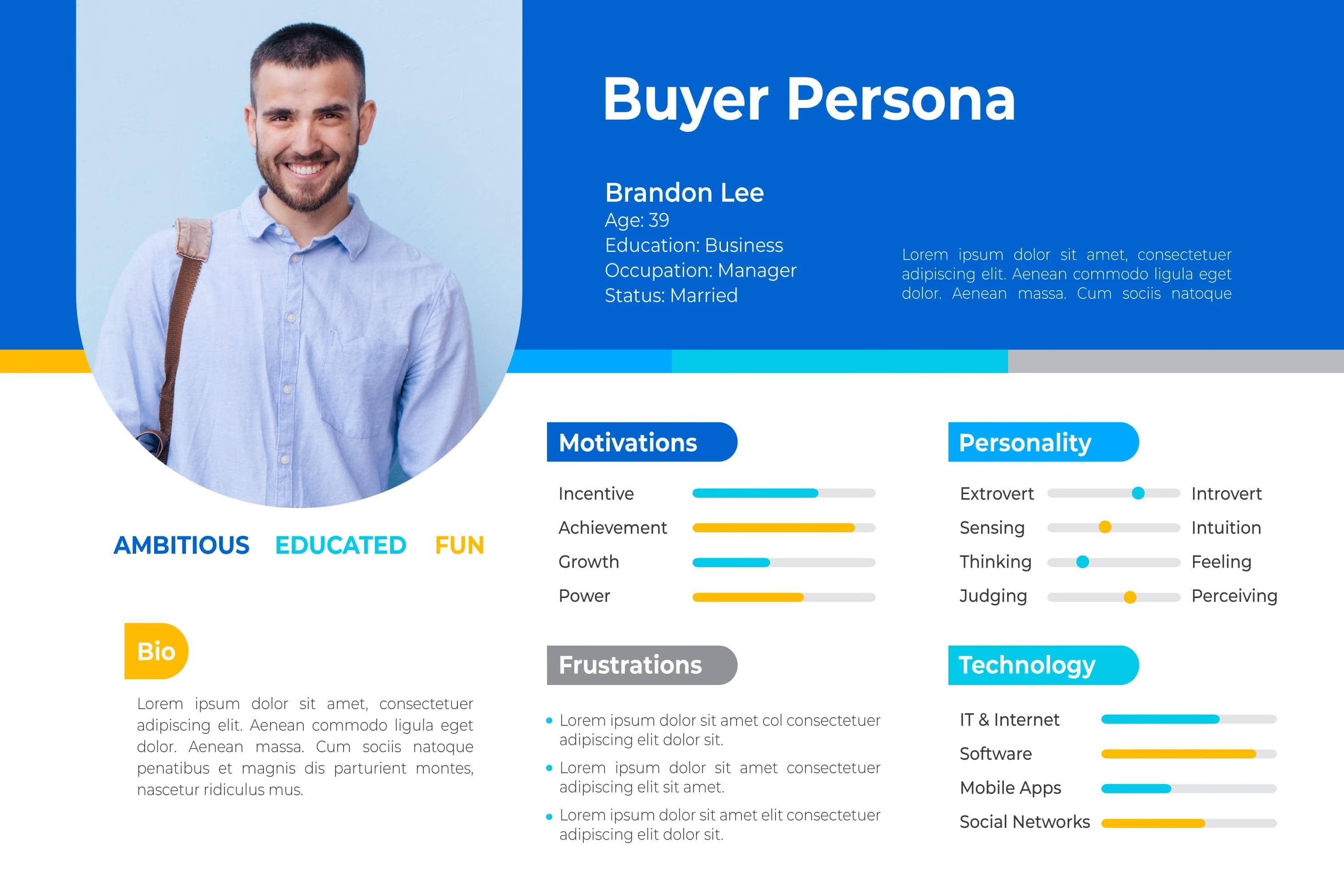
The idea behind personas is to cluster your target audience by shared characteristics such as age, position, background, fears, desires, most-used channels, jobs to be done and many more. This helps you define and get to know your dream customer better and, in turn, market your products to them more effectively.
But what is the best way to create them so you get the biggest results for your marketing?
B2B Personas: Why they matter so much for your business
- 71% of companies that exceed their revenue and lead goals have created personas of their target audience (compared to 37% of those that merely meet their goals and 26% of those that miss them)
- Marketers who use personas and align their content with the buyer's journey achieve 73% higher conversion rates from response to Marketing Qualified Lead (MQL)
- Customer-centric companies are 60% more profitable than companies that are not customer-centric
When developing buyer personas, especially for B2B, you should consider more than just demographic statistics. Companies that go beyond demographic customer analysis and use specific key triggers such as fears and challenges are more likely to generate higher revenue and work more efficiently.
They meet and exceed their revenue goals far more often than those who only use demographic data for their personas or have no buyer personas at all.
What most companies get wrong about B2B personas
"That sounds super simple, so what's the problem?" you might be asking yourself right now.
When creating personas, companies typically make these mistakes (and quite often all of them!):
- The personas are not defined precisely enough
- They are not used efficiently
- B2C personas are mistakenly created instead of B2B personas
- The persona characteristics are based on the customers they wish they had, not their actual customers
- Personas are created but never actually used
So as you can see, creating personas and then using them efficiently across your company is not as easy as you might have assumed at first.
That's why here are some tips on how to avoid these pitfalls:
Which information really matters for B2B personas
Their role in the buying process
You probably know which department of a company would use your product, but have you also figured out who in that department is able to influence and drive the buying process? If the entire company would benefit from your product, who would be the one to actually pull the trigger on the purchase?
Here are the three most important roles in the buying process and how to win them over:
👉 𝐔𝐬𝐞𝐫:
Uses your product in their day-to-day work.
- How does your product make your users' day-to-day work easier?
-> Benefit-driven messaging
- What makes your product better or different from the competition?
-> Comparison table + comparison pages
- Show how users' day-to-day work has changed
-> User testimonials
Is responsible for the budget and ultimately makes the purchase decision.
- What is the ROI of investing in your product?
-> Calculators, case studies with numbers, price comparisons with the competition
- Does the product work for the decision maker's exact use case?
-> Industry-specific case studies, implementation process
- What could go wrong, are there any risks?
-> If so, make all related information accessible and provide a solution for it
👉 𝐁𝐥𝐨𝐜𝐤𝐞𝐫:
Isn't very involved in the decision-making process, but can block it.
- What do other blockers think of the product?
-> Testimonials, case studies
- How much has your product contributed to other companies' business goals?
-> Success stories, testimonials
- Is your company a trustworthy partner?
-> Testimonials, show your company
Don't waste time marketing to the wrong people or trying to sell to someone in a company who doesn't have the authority to make a decision. There are usually several people in different departments who can make this decision, so try to find out who has the most influence and the most purchasing power.
Fears and challenges
How can you help your customers, and what keeps them up at night? Here are some questions you should ask your persona:
- What stresses them out?
- What are they afraid of?
- Which challenges can your product eliminate?
- Why would they be afraid to buy your product?
- What important problem does your product solve for them?
Once you understand these pain points, you can develop more targeted marketing tactics to address these fears and challenges and propose solutions.
Drivers and motivators
To develop an effective B2B persona, you need to understand not only the goals of the company as a whole, but also the goals of the person(s) making the purchase decision.
- Where does the company or the person want to go?
- Does the company want to grow faster, become more efficient, cut costs?
- Could your product help this person move up in their company?
- Does your product help them reach their target goal faster?
Organizational goals and priorities
Sometimes marketers also face the challenge that the customer's company culture isn't aligned with your buying cycle. For these kinds of companies, something usually has to go wrong first before they make a change.
- What kind of companies could your product serve?
- Would this company be open to complex products and solutions?
- Does your product or solution fit the company culture?
Problems and questions
Dig into which open questions or problems come up in the customer's current situation:
- How does their business currently run?
- Which systems do they already use, and what problems do those cause?
- Which of your competitors do they use?
- How can you make their work easier?
- Does your product make their work so much easier that they would switch to it?
How to define B2B personas precisely enough
Long story short: you have to talk to the people who either are your customers or deal with them directly. That's the only way to get high-quality, precise results. So here are some groups you should definitely talk to in order to define your personas more precisely.
Surveys or interviews with customers and prospects
One of the easiest ways to get information from customers and prospects is to include automated surveys, for example as part of your email marketing plan. Interviewing customers and prospects takes a bit more effort, but it shows your customers that you care about them. You might even win new customers along the way.
For this purpose, we've created an interview guide that covers the most important questions to ask your customers and prospects.
Talk to your sales team
Talk to your team and find out what works for them and what doesn't.
Analyze internal databases
Even if it's only a small database, you can find really valuable information about who buys and why.
Ask your leadership team
Your leadership team may have some ideas that aren't being used properly or at all.
Ask your customer service team
These are the people who deal most with the questions and problems of your current customers. By surveying and interviewing them, you can not only improve your own products and solutions, but also find out why customers turn away from their current solutions to do business with your company.
How to use your personas efficiently across your company
Don't waste time on details that don't really matter
Creating personas can be time-consuming, especially if you focus on the wrong characteristics. Does it really matter to your business whether your persona is called Tim or Tom? Whether they are 30 or 35 years old? Whether he has 1 child or 3 children? Probably not.
Better focus on who is actually making purchases
Navigating between different companies and stores can take a lot of a salesperson's time. If you know exactly who to market your product to and who to contact, you can continuously increase your sales and use your time more effectively.
Integrate your personas across multiple levels of your organization
Here are some of the best areas of your business where you can incorporate B2B personas:
- Sales training kits
- Training material for new employees
- Internal marketing documents
- Memos to employees with surveys that ask for more persona feedback
- creative departments
If you integrate your personas into these areas of your company and they become part of your corporate culture, you can also use the benefits of personas for yourself in the long term and sustainably.
As you can see, even though it can be time-consuming, it is worthwhile to set aside enough time for the precise creation of personas in order to realign your marketing with them. If you want to get started with your personas right now, you can copy our free persona template and fill it out right away 🙌🏼